The 8171 Benazir Income Support Program (BISP) has been a pivotal initiative aimed at providing financial assistance to vulnerable populations in Pakistan. As the program evolves, the introduction of payment options for beneficiaries without biometric verification marks a significant shift in its operational framework.
For the 2025-26 payment cycle, the government is set to roll out updates that will allow eligible individuals to receive the 13500 payment without undergoing the usual biometric checks. This article explores the implications of this change, detailing the eligibility criteria, the process for receiving payments, and the broader impact on communities, while also addressing the challenges that may arise from this new approach.
Overview of the 8171 BISP Payment Scheme
History and Purpose of BISP
The Benazir Income Support Programme (BISP) was launched in 2008 with a noble purpose: to provide financial assistance to low-income households in Pakistan. Named after former Prime Minister Benazir Bhutto, this initiative was designed to alleviate poverty and help families meet their basic needs. Over the years, it has evolved into a crucial safety net for millions, offering cash transfers to enhance social welfare and improve living standards across the country.
Funding Sources and Allocation
BISP’s funding comes from a mix of government budget allocations and international donor contributions. The program aims to distribute funds judiciously, ensuring that aid reaches those who need it most. Allocations are often adjusted based on socio-economic needs, with a focus on maximizing impact. So, whether you’re a government official or just a curious onlooker, rest assured that a lot of thought goes into making every rupee count!
Understanding Biometric Verification in BISP
Importance of Biometric Data
Biometric verification plays a vital role in the BISP framework, acting as a digital lock and key to secure funds for the right beneficiaries. By using unique identifiers like fingerprints and iris scans, the program reduces fraud and ensures that assistance reaches intended recipients. It’s like having a high-tech bouncer at the door of a very important club—only the right people get inside!
Current Biometric Verification Process
The current biometric verification process involves beneficiaries enrolling their biometric data at designated centers. This data is then stored securely and used during payment disbursement to authenticate identities. Think of it as a digital handshake—once you’ve shaken hands with the system, you’re all set to get your payments. While the process has been a game-changer in increasing transparency, it has also posed challenges for those without access to biometric facilities.
Eligibility Criteria for 13500 Payment Without Biometrics
Who Qualifies for Non-Biometric Payments?
Certain groups are eligible for receiving the 13500 payment without the need for biometric verification. Typically, this includes individuals who face difficulties accessing biometric facilities due to geographical, physical, or other constraints. If you have a compelling reason and can provide necessary documentation, you might just find yourself on the list of lucky recipients!
Verification of Eligibility
Eligibility verification for non-biometric payments is conducted through a series of checks. Local authorities and social welfare departments often step in to validate the claims of potential beneficiaries. If the paperwork is in order and the reasons are solid, you could be in for a pleasant surprise come payment time. Remember, though, that like a good detective novel, some legwork is involved in piecing together the eligibility puzzle!
Key Updates for the 2025-26 Payment Cycle
New Policy Changes
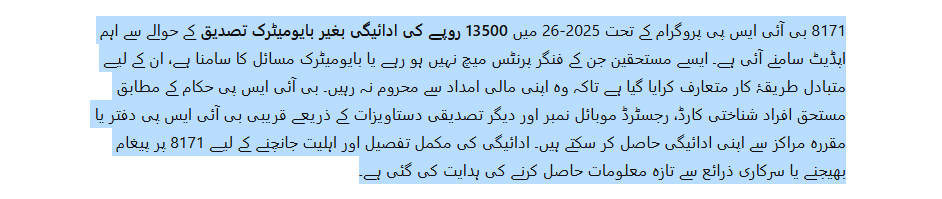
As we gear up for the 2025-26 payment cycle, several new policy changes are on the horizon. The government is looking to streamline payment processes and enhance accessibility for all beneficiaries. This could mean more flexibility around biometric verification, potentially paving the way for a smoother experience for those who qualify for the 13500 payments without biometrics.
Timeline for Payment Distribution
The timeline for payment distribution is also getting a refreshing update. Beneficiaries can expect payments to roll out in a phased manner throughout the year, rather than just lump sum payments. So, whether you’re counting the days until the next payment or just trying to keep track of your budget, mark your calendars and stay tuned for official announcements to avoid any surprises!
Process for Receiving Payments Without Biometric Verification
Steps for Beneficiaries
Beneficiaries looking to receive their 8171 BISP payments without biometric verification will need to follow a straightforward process. First, they should ensure they are registered in the BISP database. Next, they must visit designated payment centers or banks where BISP disbursements are made.
Upon arrival, beneficiaries should present their CNIC (Computerized National Identity Card) to the staff for verification. After successful verification, the payment will be processed, and beneficiaries can collect their cash or funds electronically.
Required Documentation
To facilitate a smooth payment process, beneficiaries must present certain documents. Primarily, a valid CNIC is essential as it serves as proof of identity and eligibility. Additionally, it’s advisable to have a photocopy of the CNIC, as some payment centers may require it for their records. If applicable, any other relevant documents pertaining to the beneficiary’s enrollment in the BISP program, such as registration letters, can also be helpful.
Impact on Beneficiaries and Communities
Short-Term Effects
The immediate impact of receiving payments without biometric verification is generally positive. Beneficiaries enjoy quicker access to funds, which can alleviate financial stress and improve their ability to meet daily needs. Communities may see a boost in local economies as the influx of funds enables increased purchasing power, benefiting nearby businesses and services.
Long-Term Implications
While short-term effects are encouraging, long-term implications require careful consideration. The reliance on non-biometric payments may lead to confusion about eligibility and program integrity, potentially undermining the trust of beneficiaries. Moreover, if fraud becomes rampant, it might prompt further scrutiny and lead to additional administrative hurdles, complicating beneficiaries’ access to support in the future.
Challenges and Concerns Related to Non-Biometric Payments
Risk of Fraud and Misuse
One of the most pressing concerns with non-biometric payments is the risk of fraud. Without the added layer of biometric verification, there’s a heightened chance for individuals to exploit loopholes, leading to unauthorized access to funds. This not only impacts the program’s budget but also raises questions about the fairness and equity of disbursements.
Administrative and Logistical Issues
The shift to non-biometric payments introduces various administrative challenges. Payment centers may face an influx of beneficiaries requiring assistance, leading to longer wait times and potential errors in processing payments. Additionally, tracking transactions and maintaining accurate records becomes increasingly complex, raising concerns about the program’s overall efficiency and effectiveness.
Future Prospects for the BISP Program
Potential Policy Revisions
In light of the challenges that arise from eliminating biometric verification, future revisions of BISP policies may be in order. Policymakers might consider reintroducing biometric measures alongside non-biometric options to strike a balance between accessibility and security. Additionally, enhancing awareness and education around BISP procedures can empower beneficiaries and reduce misunderstandings.
Long-Term Sustainability of the Program
For the BISP program to remain sustainable in the long run, it must adapt to the changing needs of its beneficiaries while addressing the emerging risks associated with non-biometric payments. Investing in technology and infrastructure improvements can streamline payment processes and enhance security measures.
Moreover, fostering community engagement and feedback can help tailor the program to better serve the populations it aims to support.In conclusion, the shift towards allowing 8171 BISP payments without biometric verification represents a significant transformation in how financial assistance is distributed to those in need.
While this change aims to streamline the process and enhance accessibility for beneficiaries, it is essential to remain vigilant about potential challenges such as fraud and administrative hurdles. As the 2025-26 payment cycle unfolds, the success of this initiative will depend on effective implementation and ongoing support for the communities it serves.
Ultimately, the goal remains to uplift and empower the most vulnerable segments of society, ensuring that they receive the assistance they require to improve their livelihoods.
Frequently Asked Questions
1. Who is eligible for the 13500 payment without biometric verification?
Eligibility for the 13500 payment without biometric verification includes individuals who meet specific criteria set by the BISP, which may include income thresholds, family size, and current enrollment in the program.
2. How can beneficiaries receive their payments without undergoing biometric checks?
Beneficiaries can receive their payments by following the designated process outlined by BISP, which typically involves submitting required documentation and verifying their eligibility through alternate means.
3. What measures are in place to prevent fraud with non-biometric payments?
BISP is expected to implement various administrative checks and balances to mitigate the risk of fraud, including regular audits, verification of documentation, and community monitoring.
4. Will this change affect the overall funding and sustainability of the BISP program?
The long-term impact on funding and sustainability will depend on the implementation of this new payment method and its effectiveness in reaching the intended beneficiaries without compromising program integrity.
